

The Complete Transformation Of '60s & '70s Icon Joan Baez
We may receive a commission on purchases made from links.
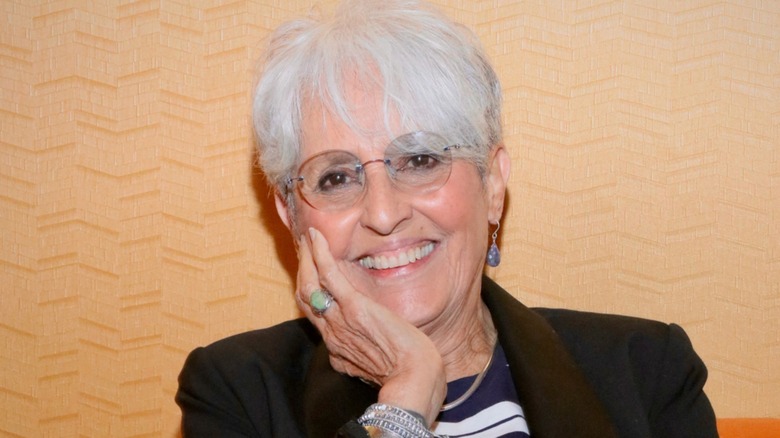
Not only is Joan Baez a hugely talented musician who was at the forefront of the folk music scene in the late '50s, '60s, and '70s, but she's also spent her lifetime unwaveringly fighting for social change. "Before I could even verbalize it, I would say that a social consciousness was born in me before the voice developed," she told She Does the City in 2023. That rare mix of raw talent and a genuine desire to change the world has made Baez a force to be reckoned with and a trailblazer who's always been more interested in chasing justice than dollars. "Put it this way‐I had a choice of whether I wanted to be a millionairess or not, and I decided against it," she told the New York Times in 1972. "But I think it's pointless to have stored up X‐million amounts of dollars when they could be put to use somewhere," she added.
The "Diamonds and Rust" and "The Night They Drove Old Dixie Down" hitmaker also made it clear she never even considered parking politics at the door for the sake of her singing career. "There isn't any way to separate my political life—or what most people would call my political life, because I don't use the term in quite the same way most people do—from my career, because it's the same thing," she lamented. And that's never wavered throughout Baez's transformation.
1941: Joan Baez was born into a Quaker family and discovered music young
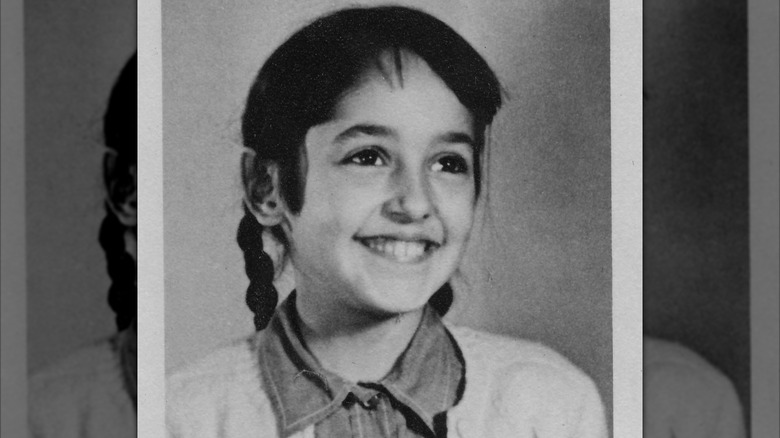
Joan Baez was born in New York in 1941 into a Quaker family. Though she didn't strictly practice Quaker teachings as she got older, she told Forbes, "I learned about silence, I learned about the whole philosophy of Quakerism where you don't get to kill anybody." The family moved around a lot while Baez was young and spent time in places such as the U.K., France, Spain, Switzerland, Canada, and even Iraq.
The seasoned traveler, who learned how to play guitar and ukulele early, started to dabble in music, but told NJ Press Media (via The U.S.A. Songwriting Competition) it wasn't something she considered as a career because she wasn't much of a long-term planner. It wasn't until she was 13 that she truly realized a music career could be in her future. Baez saw singer/songwriter Pete Seeger perform at a Democratic fundraiser in 1954 and realized that was what she wanted to do.
1954: Her music career kicked off in her teenage years
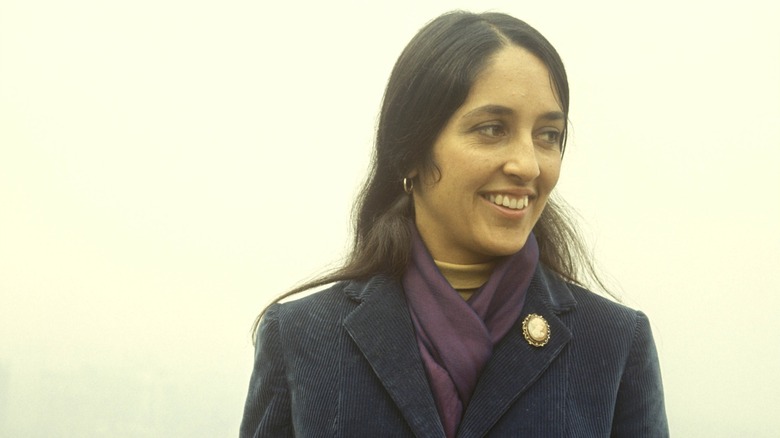
After Joan Baez realized she could be a full-time musician, she began performing in public. In her teens, she performed small gigs around her then-hometown of Boston, before making waves at one of her biggest performances at the time at the 1959 Newport Folk Festival. But her teen years weren't the easiest. At 15, Baez began going to therapy for depression and anxiety. "[Therapy] got me around and under and over issues, and helped me survive, and have some kind of quality of life," she said on the "On Being with Krista Tippett" podcast.
Baez was 19 when she released her first album, the folksy "Joan Baez," in 1960. She told Rolling Stone she recorded her debut over just four nights — and it was far from a glamorous experience. "We were in some big, smelly ballroom at a hotel on Broadway, way up by the river. We couldn't record on Wednesday nights because they played bingo there. I would be down there on this dirty old rug with two microphones, one for the voice and one for the guitar. I just did my set; it was probably all I knew," she said. The release peaked at No. 20 on the Billboard 200 Album chart and was certified Gold in the U.S., which was no small feat for a debut folk album.
More successful albums soon followed. In 1963, she scored her highest-charting entry on the Billboard 200 with "Joan Baez in Concert, Part 2," which reached No. 7. "It was the right years, the right decades. And I was fortunate enough to be there," she'd tell The Hollywood Reporter of her major, quick success.
1961: Bob Dylan had a huge impact on Joan Baez and her music
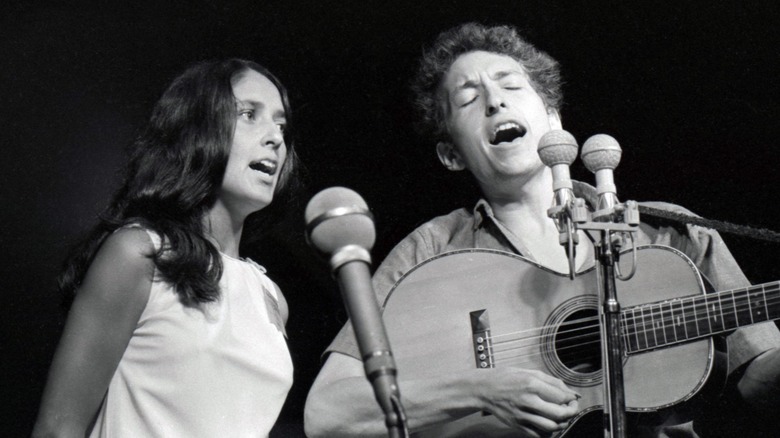
In 1961, Joan Baez met fellow musician Bob Dylan. She was the bigger star at the time and recalled meeting him after someone recommended she (and her boyfriend at the time) watch his set at a live music event. "We saw this scruffy little pale-faced dirty human being get up in front of the crowd and start singing his 'Song to Woody.' I, of course, internally went completely to shreds, 'cause it was so beautiful," Baez told Rolling Stone, though she couldn't make her instant affection for Dylan known because of her boyfriend.
Baez and her partner at the time eventually split, and she started dating Dylan, which impacted her music. The two regularly performed together, and she released the 1985 track "Diamonds and Rust" about him, plus the 1968 cover album of his songs "Any Day Now." But, as much as this romance fascinated the world, it didn't go the distance. Baez told Rolling Stone their connection wavered because she was staunchly against drug use. Speaking to the Independent, attributed the demise of their romance to the immense fame he achieved, which she suggested pushed her out of his life.
But it seems there are no hard feelings between the former lovebirds. "It is such an honor to have been a part of his life and to share that music and to have, you know, loved him," she told AXS in 2025. Dylan was equally complimentary of his ex-girlfriend a decade earlier. "I learnt a lot of things from her. For her kind of love and devotion I could never repay that back," he said at a MusiCares event (via Far Out).
1967: Joan Baez's strong activism got her arrested, she tied the knot, and fell pregnant
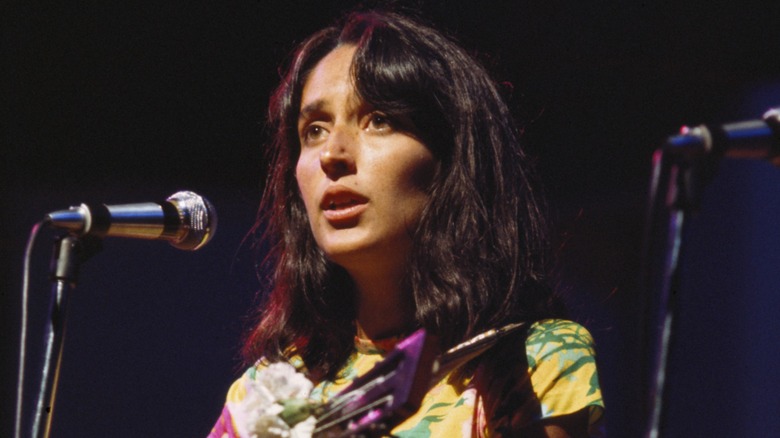
By 1967, Joan Baez had cemented her position as a staunch activist and folk music trailblazer. The star regularly took activism to the next level through protests and was arrested and imprisoned for 10 days, then another 31 days, for taking part in protests opposing the Vietnam War. That strong dedication to bettering the world was also represented in her music. "[I] was definitely trying to write a song that had some relevance and the general malaise in the world, the different countries and the different dictatorships and so on," she told Parade.
By 1968, the 27-year-old was living in California and ready to settle down. She tied the knot with fellow activist David Harris and became pregnant with their son Gabe shortly after. In 1969, she performed at the legendary Woodstock festival, where she took to the stage six months pregnant. "David was in jail, I was pregnant, and it was all about changing the world and taking risks. I know people got bored with me talking about it, but my mission continued, even into this big festival," she recalled to the Telegraph, referring to Harris' arrest for refusing to be drafted into the armed forces.
Baez addressed how important her activism and music were at the time during her Rock & Roll Hall of Fame induction speech. "One cannot overlook the folk music of the '60s, and the immense effect it had on popular music, including rock 'n' roll. Nor can anyone overlook the role that I played in that phenomenon," she said.
1972: The singer moved record labels and life changed dramatically
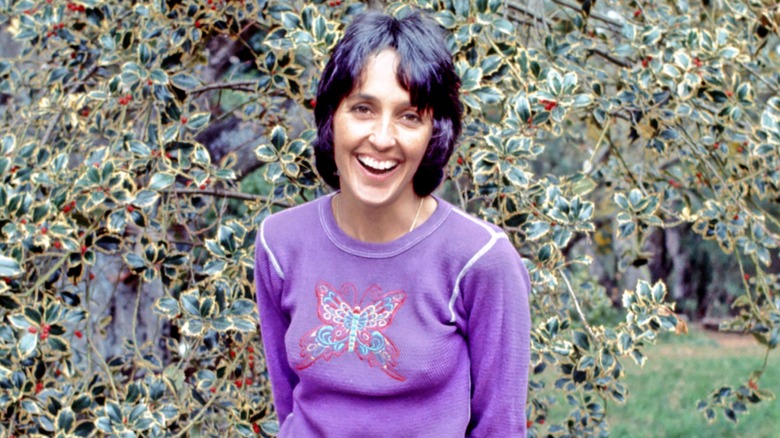
Joan Baez kicked off the '70s with a new direction. Now a mom of one, she left Vanguard Records, her original record label, and moved to A&M Records. She continued to release music with meaning, including the single "Song of Bangladesh," but the transformative time took its toll on her. That same year, she and David Harris divorced. Baez told the Telegraph of the demise of her marriage, "[I] was completely promiscuous," as she shared she struggled with intimacy.
Baez, who confirmed she donated proceeds from her gigs to her foundation, elaborated on the tough time in multiple interviews. "There's a period when I fell off the edge of a mountain somewhere and was really awash and in difficulties with the industry and with myself," she told Forbes. She also gave insight into her headspace to On A&M Records, saying, "It was disconcerting after the sixties when everything changed. A lot of what I went through had to do with personal ego."
Her 1972 album "The Joan Baez Ballad Book" and the 1973 release "Where Are You Now, My Son?" didn't see the same success as her previous releases. The former reached No. 188 on the Billboard 200 chart, while the latter only fared slightly better at No. 138. She appeared to reference interest in her music simmering down into the '70s, sharing, "[...] it is ego bashing if you have been a superstar and then you go on an eight-year period when record companies are no longer interested, when you come to terms with yourself and figure out what you do."
1985: Joan Baez continued to push forward with music and activism -- and dated Steve Jobs
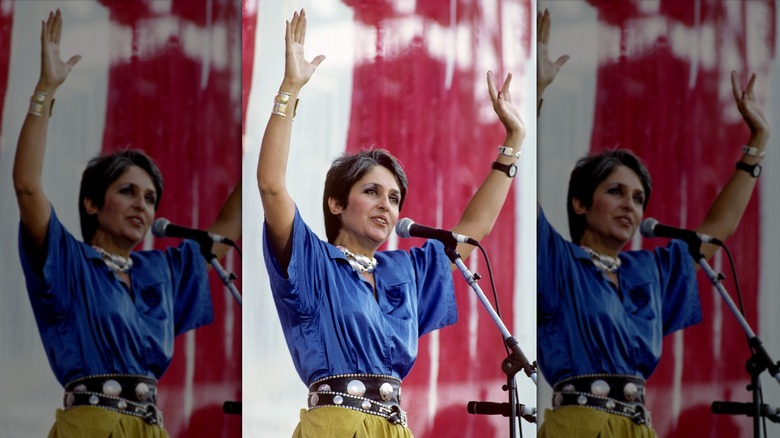
Though the spotlight on Joan Baez's life and career dimmed a little in the '80s, that didn't stop the star from singing, songwriting, and practicing activism. She continued to release music and made several notable appearances, including performing "Amazing Grace" at the legendary 1985 Live Aid charity concert. "Lip service is really easy. And that's, you know, I guess I learned that very early. But as soon as you try to live out some of those principles, you're going to run into serious trouble," she told "CBS This Morning" in 1989, seemingly suggesting her dedication to activism hindered her from becoming an even bigger star. "You can't sell all those millions of records for sure and also do something that's going to agitate," she added.
That same decade, Baez made headlines for more than just her music and her beliefs as she embarked on an unexpected romance with the late Apple mogul Steve Jobs. Baez opened up about their relationship to Rolling Stone, recalling, "We were an interesting item. We disagreed on almost everything. But he was sweet to me. He had a sort of boyish charm and was so alive with his discoveries."
1990: Therapy helped Joan Baez come to terms with her childhood trauma
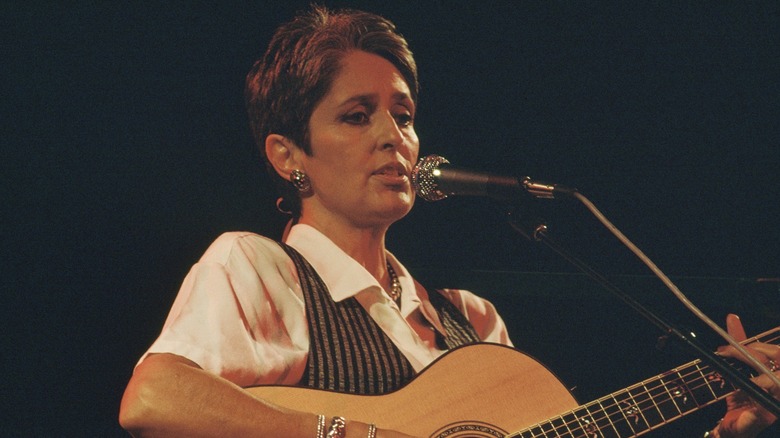
At 50 in 1990, Joan Baez was able to come to terms with her difficult childhood. "I couldn't stand my life. It was seriously dark and painful," she told Rolling Stone, admitting she dealt with multiple crippling phobias later in life. Baez became a celeb who spoke out about how therapy improved her life as she returned to therapy and told The Hollywood Reporter it helped her uncover repressed childhood abuse.
Baez also spoke to KCRW about the difficult period. "I thought: Okay, it's down in there somewhere, let me see if I can go down and find it and deal with it, which is what I did. And it took years," she said of her very personal journey. She was then diagnosed with dissociative identity disorder (previously known as multiple personality disorder), where a person has two or more distinct identities or personality states. "They came very quickly for a number of years. And because they came in the form of multiple personalities, it was like my own family," Baez said.
2009: The superstar proved she didn't need a relationship to make her happy
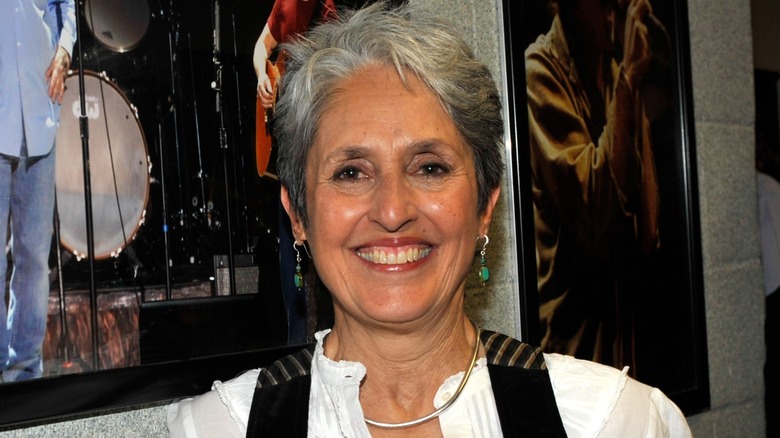
Yet another way Joan Baez fought for social change was by being living proof that women don't need long-term romantic relationships to feel happy and fulfilled. Speaking to the Telegraph in 2009, the single star made it clear she wasn't actively looking to join the ranks of women who found their happily ever after later in life. "It seems like an enormous amount of work to construct something I've never known," she said when asked about romantic relationships. "If I'm happy, which I am. And if it didn't – whatever it is – come my way, then maybe someday I'd be terribly lonely, or maybe I won't be terribly lonely, because I will have constructed my life in a way that it makes sense," she added.
The star, who embraced her natural gray hair in her 60s, also got candid about a topic all too many working moms have experienced — mom guilt. She spoke about giving birth to Gabe at the height of her career while traveling the world. "It nags me all the time," she said, but shared that her son had reassured her he had a happy childhood. "As we know, forgiveness of oneself is the hardest of all the forgivenesses," the singer, who had become a grandmother to Gabe's daughter, added.
2017: She wrote her first song in 25 years -- aimed at Donald Trump
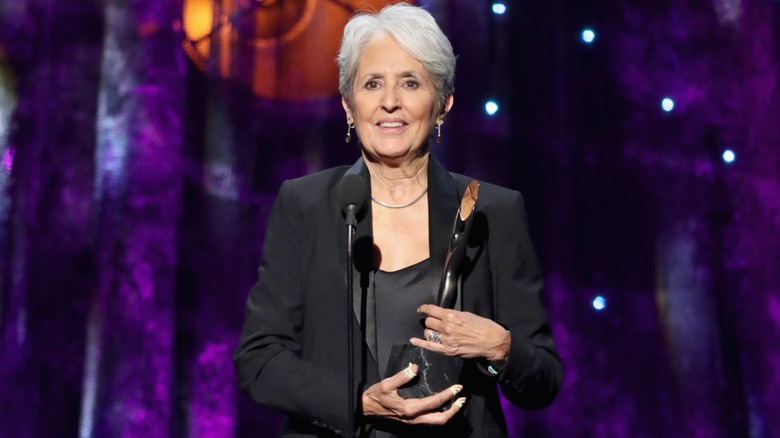
Joan Baez had been largely absent from the music scene when 2017 rolled around, but she couldn't help but grab her guitar and write a song when Donald Trump took office for his first term. The song was Baez's first in 25 years. She called the comedy song that took shots at Trump "Nasty Man" and uploaded the track to YouTube, where it has garnered more than 1.1 million views at the time of writing.
Her return to the spotlight also included her long-overdue induction into the Rock & Roll Hall of Fame. Baez reflected on her influential career in her touching acceptance speech, while tributes flooded in. Singer-songwriter Jackson Browne inducted his fellow musician and shared that the first album he bought was by Baez. "Right away I was taken with what was, for me, completely new music. Just voice and guitar, but so ethereal, powerfully in tune, deeply expressive, dramatic, hypnotic. By the third song, I was completely mesmerized," he recalled of the first time he heard her music.
2018: Joan Baez officially retired from touring
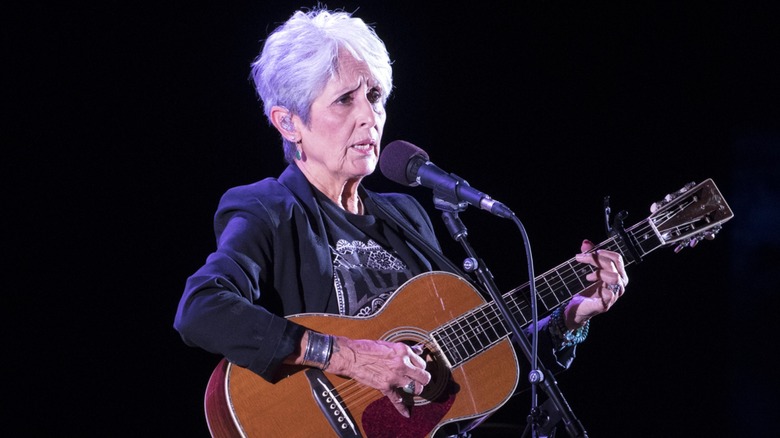
Joan Baez announced in 2017 that she'd embark on her farewell tour in 2018. She told Variety she was struggling to keep her voice in its best condition as she grew older (she was 76) and wanted to focus on another passion: painting. But unlike many stars who have more than one final tour, Baez really meant it when she took a step back.
She told The Hollywood Reporter in 2023 she hadn't so much as touched her guitar since she ended her touring career. "The only time I regretted it a little bit was if there was a one-off, a thing where it's just 'go and sing a couple of songs with so and so.' But I don't really want to gear up for it. There's a little bit of that wish still there but it's not worth thinking about," she said, revealing she'd hung up her guitar on her wall at home.
2023: The folk superstar shared her life with the world via a candid documentary
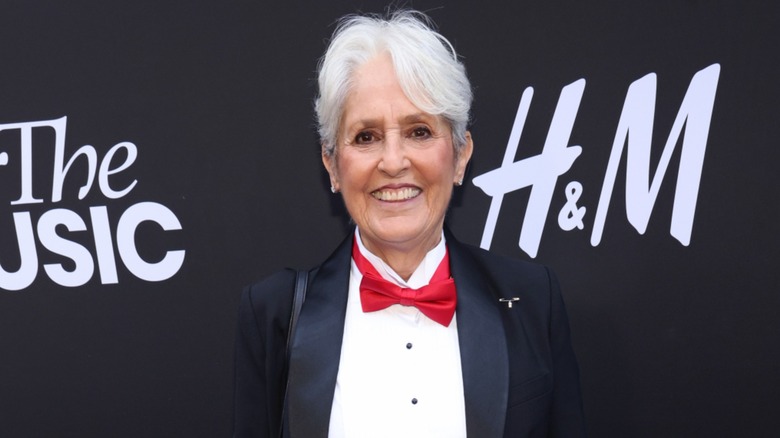
Though Joan Baez had taken a step back from touring, that didn't mean she wasn't still in the spotlight in her own way. In 2023, she put her life and work on camera for the documentary "Joan Baez: I Am a Noise." "I really want to leave an honest legacy. So that's what we attempted to do," she told The Hollywood Reporter of the candid project, which looked back at her decades-long career.
That same year, Baez proved she was a celebrity confronting aging with confidence. She shared her beauty mantra with The Guardian after a fan asked how she continued looking her best in her 70s. "Look in the mirror and deal with it! I made a decision not to go with all the facelifting. It was not an easy decision because everybody does it," Baez said. She added that she noticed her face had changed a lot in recent years and noted, "This ageing stuff is not for the faint-hearted, for sure."
2024: Joan Baez released a poetry book and performed occasionally
In 2024, Joan Baez released her poetry book, "When You See My Mother, Ask Her to Dance: Poems." She told KCRW the poems were written years earlier by some of the personalities (which she referred to as "the entities") who presented themselves as part of her personality disorder. She told the Poetry Society of America she was still acutely experiencing the disorder but had developed the tools to manage it. Her time away from touring had created a safe space for Baez to build a support system, and she seemed as happy as ever with her life in her 80s. "I have lots of very good friends now and I think that's something I couldn't have had years ago. But I do have now and I'm grateful for it," she told KCRW, reminding us why it's important to care for yourself while advocating for others.
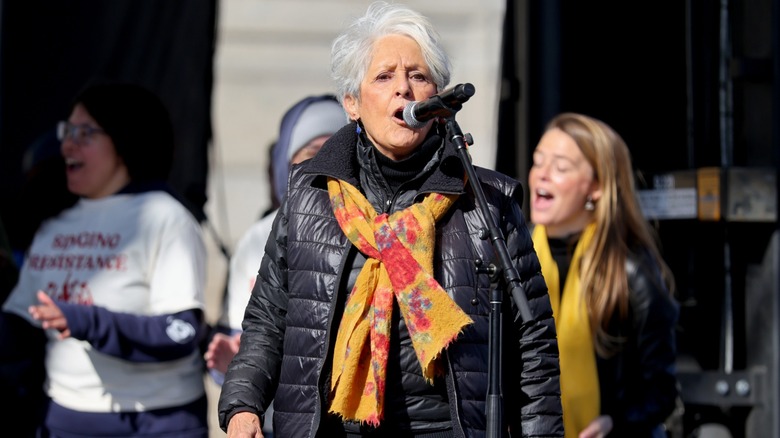
Although she'd hung up her guitar (literally), she clearly wasn't totally against the occasional return to the stage. In 2025, Baez performed as part of a San Francisco tribute concert to herself alongside fellow musicians Bonnie Raitt and Margo Price. She also took to the stage as part of the "No Kings" Rally Concert in 2026, which called out Donald Trump's suggestion that he could become king of the United States.
It's no surprise that after living such a bold, integrity-filled life, Baez had some sound advice for anyone looking to follow in her inspirational footsteps. "You've got nothing to lose. Do whatever impulse comes up," she told the Poetry Society of America. "If it's painting, if it's building a bridge, it doesn't matter. Just do it while you have time," she added. And it's clearly worked for this folk superstar.